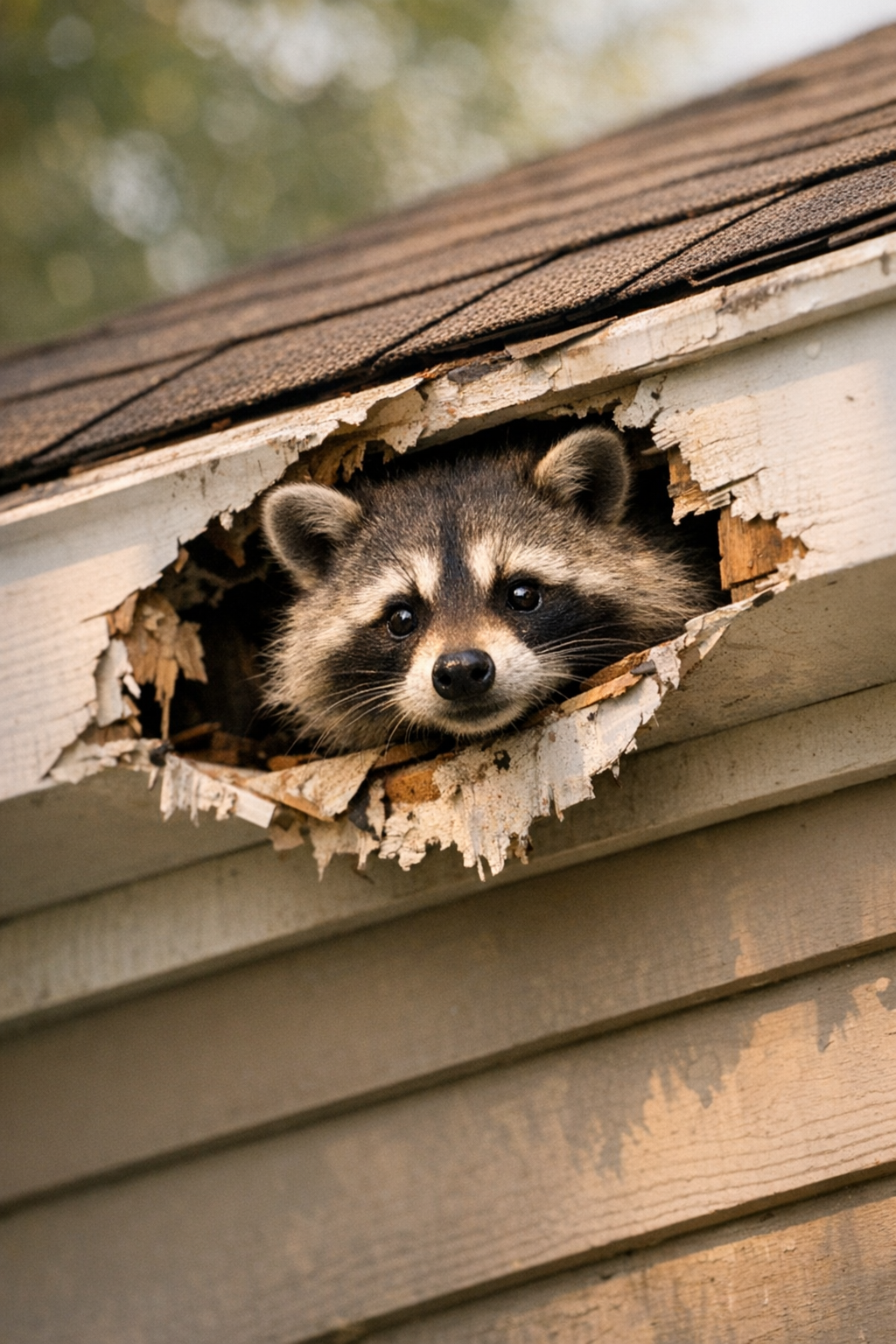
Before you ever see a raccoon on your property, you'll usually see its evidence. Tracks and droppings are the two most reliable calling cards — and learning to recognize them helps you act before a yard visitor becomes an attic resident.
Here's what to look for, where to look, and the one important safety warning about raccoon droppings that every homeowner should know.
Identifying Raccoon Tracks
Raccoon tracks are among the easiest to identify: five long, finger-like toes on both front and hind feet. The front print looks remarkably like a small human handprint, about 2 to 3 inches across. The hind print is longer — 3 to 4 inches — with an elongated heel pad, resembling a tiny flat human foot.
Because raccoons walk with a distinctive gait, tracks usually appear in paired sets: a front foot beside the opposite hind foot. Look for them in mud near downspouts, in soft soil along foundations, in snow, and — importantly — as muddy smudges going up your downspouts, deck posts, or siding. Climbing marks on the house mean the raccoon isn't just passing through; it's evaluating your roofline.
Identifying Raccoon Droppings (and the Latrine Habit)
Raccoon droppings are tubular, blunt-ended, and 2 to 3 inches long — similar in size to a small dog's, but usually darker and often containing visible seeds, berry skins, or corn. What distinguishes raccoons is the latrine habit: they repeatedly use the same communal spot, so you'll find an accumulation rather than scattered individual droppings.
Common latrine sites are the base of trees, woodpile corners, deck corners, flat roofs — and, in infestations, one corner of your attic. An attic latrine is what turns a wildlife problem into a contamination problem, soaking insulation and staining ceilings.
The Roundworm Warning
Never handle raccoon droppings without protection. Raccoon feces can carry Baylisascaris procyonis — raccoon roundworm — whose eggs become infectious in about two to four weeks and can survive in soil for years. Infection is rare but serious, and children are at highest risk because of hand-to-mouth contact with contaminated soil.
Don't dry-sweep or vacuum a latrine; that aerosolizes the material. Professional cleanup uses protective equipment, careful wetting, removal, and heat treatment of the surface — roundworm eggs resist most chemical disinfectants but are killed by flame or boiling water applied properly.
If you've found tracks on your downspouts or a latrine on your property, a raccoon is at minimum a regular visitor. Call us at (502) 200-9943 for an inspection before it becomes a tenant.