Moles and voles get blamed for each other's work constantly — the names don't help — but they're completely different animals causing completely different damage, and the control methods for one do nothing against the other. Getting the ID right is the whole game.
Here's how to tell in about thirty seconds of looking at your yard.
Mole Damage: Raised Tunnels and Volcano Mounds
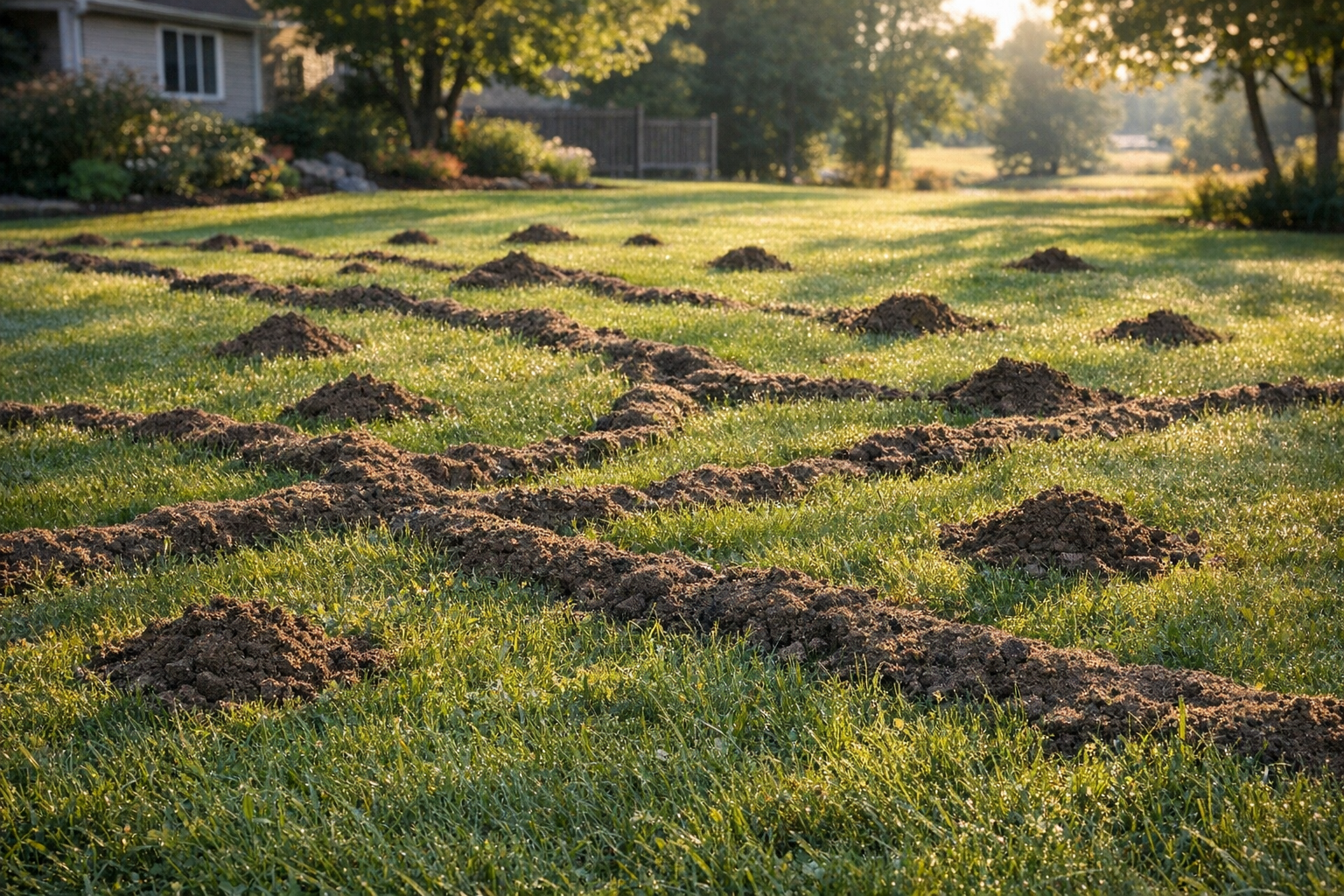
Moles are insectivores that live almost entirely underground, hunting earthworms and grubs. Their signature is the raised surface tunnel — a ridge of pushed-up turf that snakes across the lawn and gives underfoot when you step on it. The second signature is the mound: a symmetrical volcano of fluffed soil with no visible hole, pushed up from a deep tunnel below.
Moles don't eat your plants. The damage is mechanical — tunneling separates grass roots from soil, leaving brown traces across the lawn, and the mounds are mowing hazards. One mole can tunnel up to 18 feet per hour in soft soil, which is why the damage seems to appear overnight. Irrigated Louisville lawns are ideal habitat because watering keeps earthworms near the surface.
Vole Damage: Surface Runways and Eaten Plants
Voles (meadow mice) are small rodents that eat vegetation. Their signature is a network of narrow, trampled surface runways about two inches wide, connecting small open burrow holes — most visible when snow melts in late winter, revealing a maze chewed through the lawn.
Unlike moles, voles do eat your landscaping: they gnaw the bark from the base of young trees and shrubs (a pattern called girdling that can kill the plant), eat bulbs and root vegetables, and mow down perennials. Chewed bark at ground level with tooth marks about the width of a pencil tip is vole work, full stop.
A useful tell: mole damage is three-dimensional (raised ridges, mounds); vole damage is two-dimensional (surface paths, eaten plants, open holes with no mound).
Why the ID Changes Everything
Grub treatments — the classic hardware-store advice — mostly disappoint against moles, whose primary food is earthworms you can't (and shouldn't) eliminate. Effective mole control is professional trapping placed in active runs, which requires identifying which tunnels are in daily use.
Vole management is habitat and exclusion work: clearing dense ground cover and deep mulch they travel under, installing hardware-cloth cylinders around young tree trunks, and targeted rodent control during population booms, which run in multi-year cycles.
If your yard is being dug up and you're not sure by what, send us a photo or schedule an inspection at (502) 200-9943 — the treatment plan depends entirely on getting this first call right.