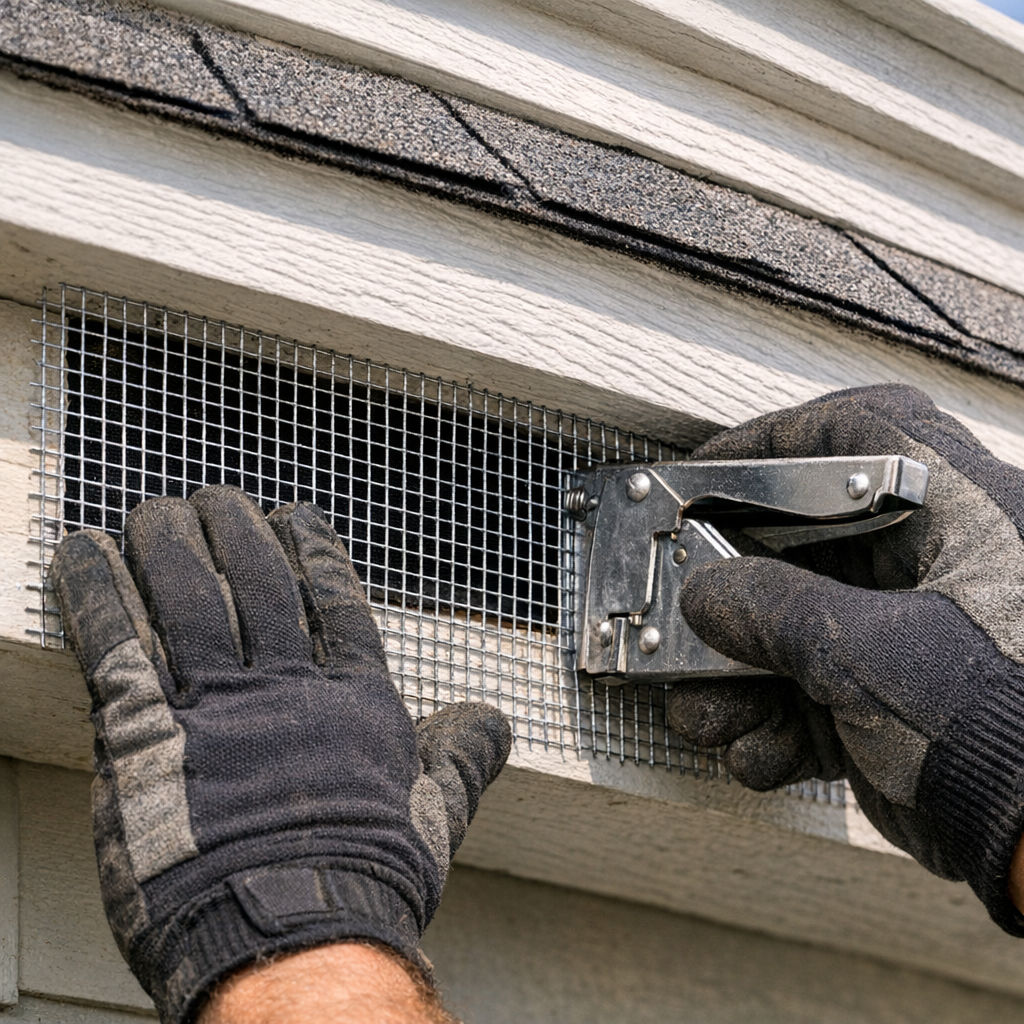
After thousands of inspections across the Louisville area, we can tell you that wildlife entry points are remarkably predictable. Animals don't get in through random holes — they exploit the same dozen structural weak spots on nearly every home, because those are the places where builders join materials and time pulls them apart.
Here's our inspection checklist, from the roof down.
The Roofline: Where Most Problems Start
Roof returns (the small dead-end pockets where the roofline meets a wall, sometimes called 'pig ears') are the number-one squirrel entry we see — a gap you often can't spot from the ground. Close behind: soffit-to-roof intersections, where a raccoon can push up loose panels; rotted fascia boards behind clogged gutters, which chew open easily; and gable vents with flimsy louvers or window-screen backing that stops insects but nothing with teeth.
Then there are the builder's openings: ridge vents with damaged end caps, uncapped chimneys (raccoons den in flues; chimney swifts nest in them), and plumbing stack boots whose rubber collars squirrels chew straight through. Bats need none of this — a gap of three-eighths of an inch along flashing or a warped rake board is enough.
Mid-Level and Ground-Level Entries
Dryer, bathroom, and kitchen exhaust vents with plastic flaps are effectively pet doors for squirrels and birds once the flap breaks. Wall penetrations for AC lines, gas, and cable are routinely oversized and sealed with foam that rodents remove. Deteriorated mortar joints in brick and gaps behind attached decks or porch roofs round out the mid-level list.
At ground level: crawl space vents with rusted screens, foundation gaps where siding meets sill plate, and the open bases of decks, sheds, and porches — the skunk/groundhog/opossum zone. Attached garages deserve special mention: a garage door with a worn corner seal admits mice all winter, and the attic above an attached garage is often the least-sealed part of the house.
How to Audit Your Own Home
Twice a year, walk the full perimeter with binoculars and study the roofline in good light: look for dark rub marks (body oil from repeated animal passage), chewed edges, lifted shingles at corners, and daylight showing where materials meet. From inside the attic, turn off the lights on a sunny day — every point of visible daylight is a current or future entry.
Remember the rule of thumb: a mouse needs a dime-sized hole, a squirrel a baseball-sized one, a raccoon a softball-sized one — and all three can enlarge something smaller.
Our inspection covers every item on this list with photos of what we find. Call (502) 200-9943 and we'll show you your home the way a raccoon sees it.