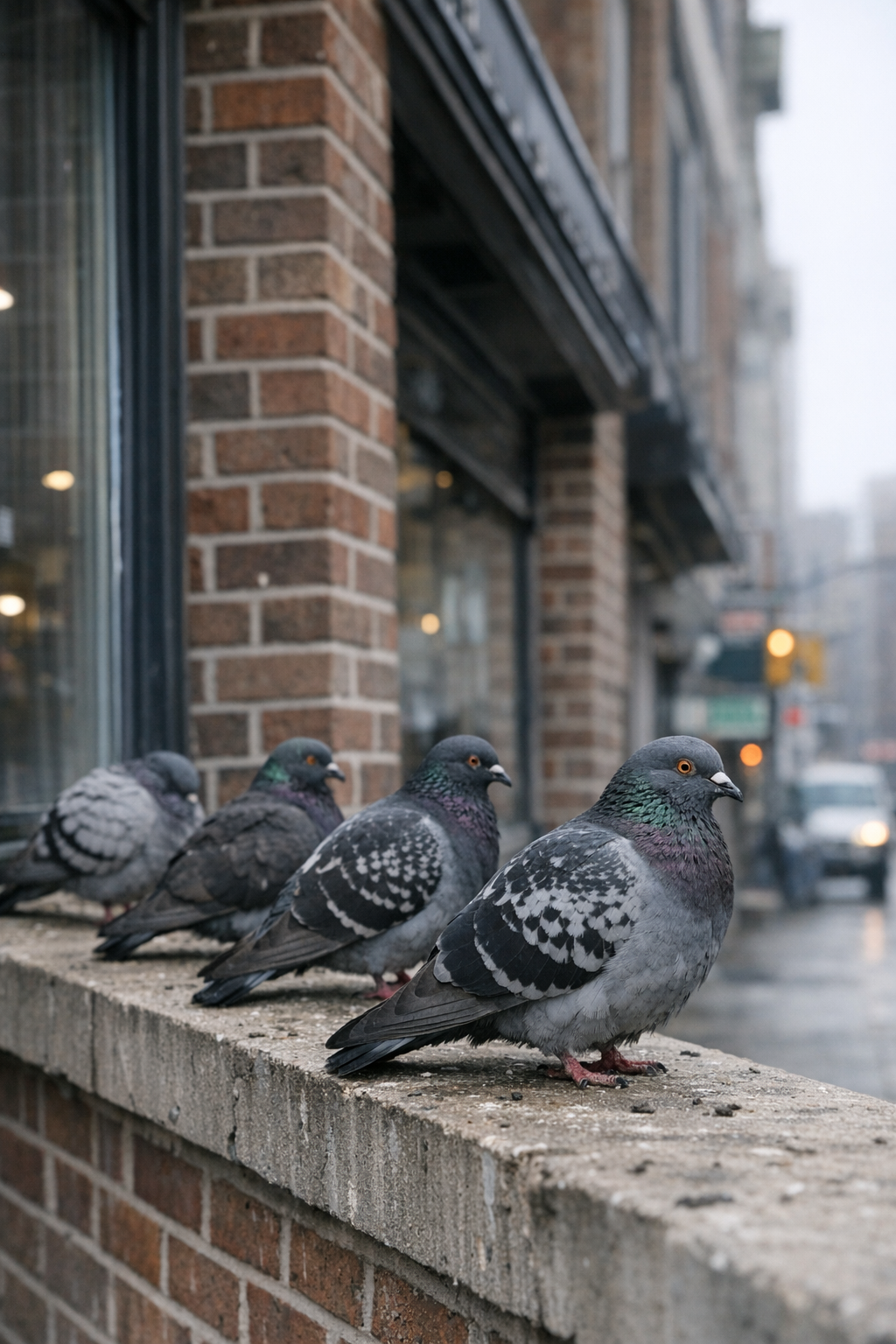
For a business, a bird problem is never just a bird problem. Pigeons roosting over your entrance mean droppings on customers and slip hazards on the sidewalk. Starlings in a warehouse mean contaminated inventory and OSHA questions. Sparrows nesting in a restaurant's signage mean a difficult conversation with the health inspector.
We handle bird control for commercial properties across the Louisville metro — retail, restaurants, warehouses, medical offices, and industrial sites. Here's how professional commercial bird management actually works.
Why Birds Choose Commercial Buildings
Commercial buildings are ideal bird habitat: flat roofs with warm HVAC units, protected ledges and signage cavities for nesting, loading docks that stay open all day, and often a reliable food source nearby. Pigeons, starlings, and house sparrows — the three species behind most commercial complaints — are all highly adapted to human structures and are not protected the way native songbirds are.
The cost of ignoring them adds up fast. Bird droppings are acidic and permanently etch paint, masonry, and metal. Nesting material clogs gutters and drainage, causing roof leaks. And accumulated droppings can harbor histoplasmosis spores, a genuine liability concern for any property with employees or customers.
The Tools That Actually Work
Effective commercial bird control matches the tool to the pressure level. Bird spikes work well on ledges and beams where birds loaf casually. Netting is the gold standard for excluding birds from loading docks, canopies, and signage — done correctly it's nearly invisible from the street. Shock track and wire systems handle architectural details where spikes would be unsightly.
What doesn't work: plastic owls, ultrasonic gadgets, and rubber snakes. Birds habituate to static deterrents within days. We see a lot of commercial properties that have spent hundreds on gimmicks before calling for a real solution.
Nest removal has a legal layer: while pigeons, starlings, and house sparrows can be handled year-round, most other birds — including woodpeckers, geese, and all native songbirds — are protected under the Migratory Bird Treaty Act. Correct species identification isn't optional.
What a Commercial Engagement Looks Like
We start with a site assessment: where birds are roosting versus nesting, what's attracting them, and which surfaces need protection. You get a written scope with photos, and we schedule installation around your business hours. For food-service and healthcare clients we document everything for inspection files.
Droppings cleanup is part of the job — we remove accumulations safely with appropriate protective equipment and disinfectants before installing deterrents, because installing spikes over contaminated surfaces just locks the problem in place.
If birds are costing your business money or worrying your inspector, call us at (502) 200-9943 for a commercial site assessment anywhere in the Louisville metro area.